

The Skill of Human Judgement
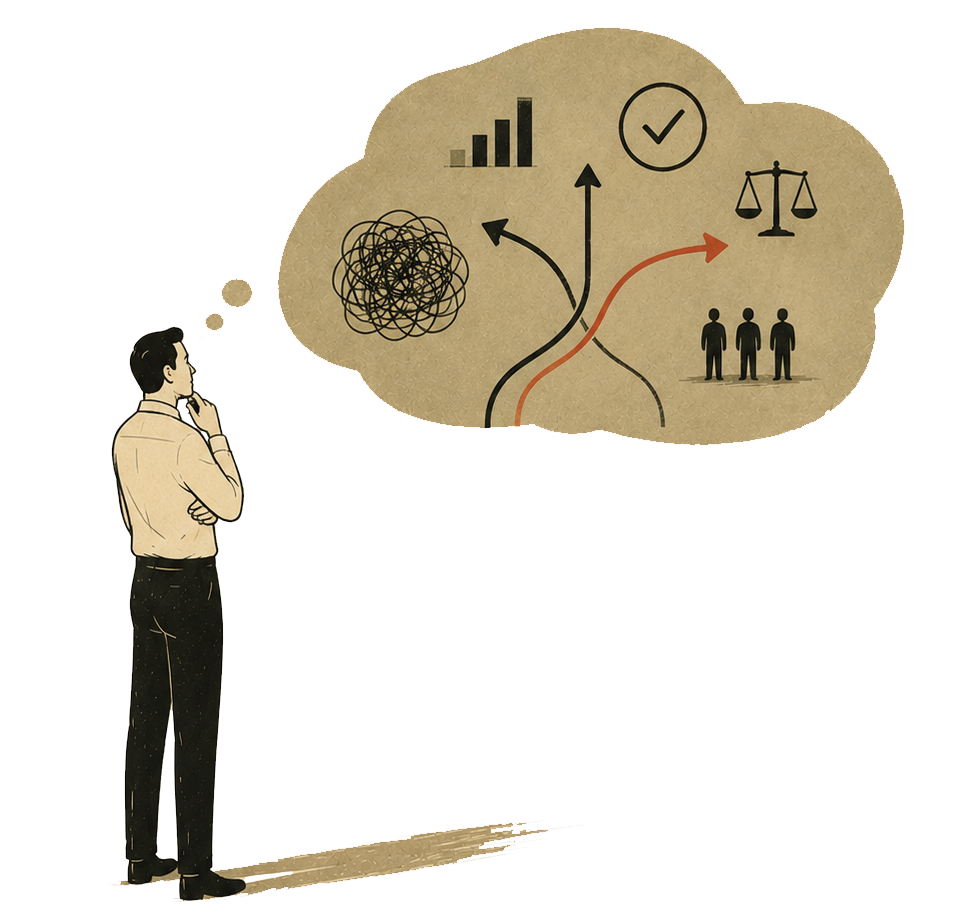
“Within the space of a few years, it has become possible to simulate knowledge and understanding of almost any topic while possessing neither.”
- Tom Chatfield, British author and tech philosopher
In an AI world, true understanding and judgement is the human skill that will make a professional indispensable. AI can assist with parts of a learning and decision making process, but it cannot fully replicate judgement when values, context, tradeoffs, and lived experience are involved. Judgement is the integration of multiple human faculties: emotional, cognitive, experiential, and ethical – all working together. Judgement is what determines decision quality. It is the difference between having information and making the right call.

The Judgement Pyramid
Most people have never considered how to deliberately develop wise judgement. We mostly learn how to make decisions through experience – through screwing up and recovering. Yes, paying attention to experiences is important. But we can do more.
Like growing any other skill, we can look at the components involved and identify what aspects need attention. I created the Judgement Pyramid as a meta-view teaching tool, so that one can see how their judgement can be purposely improved.
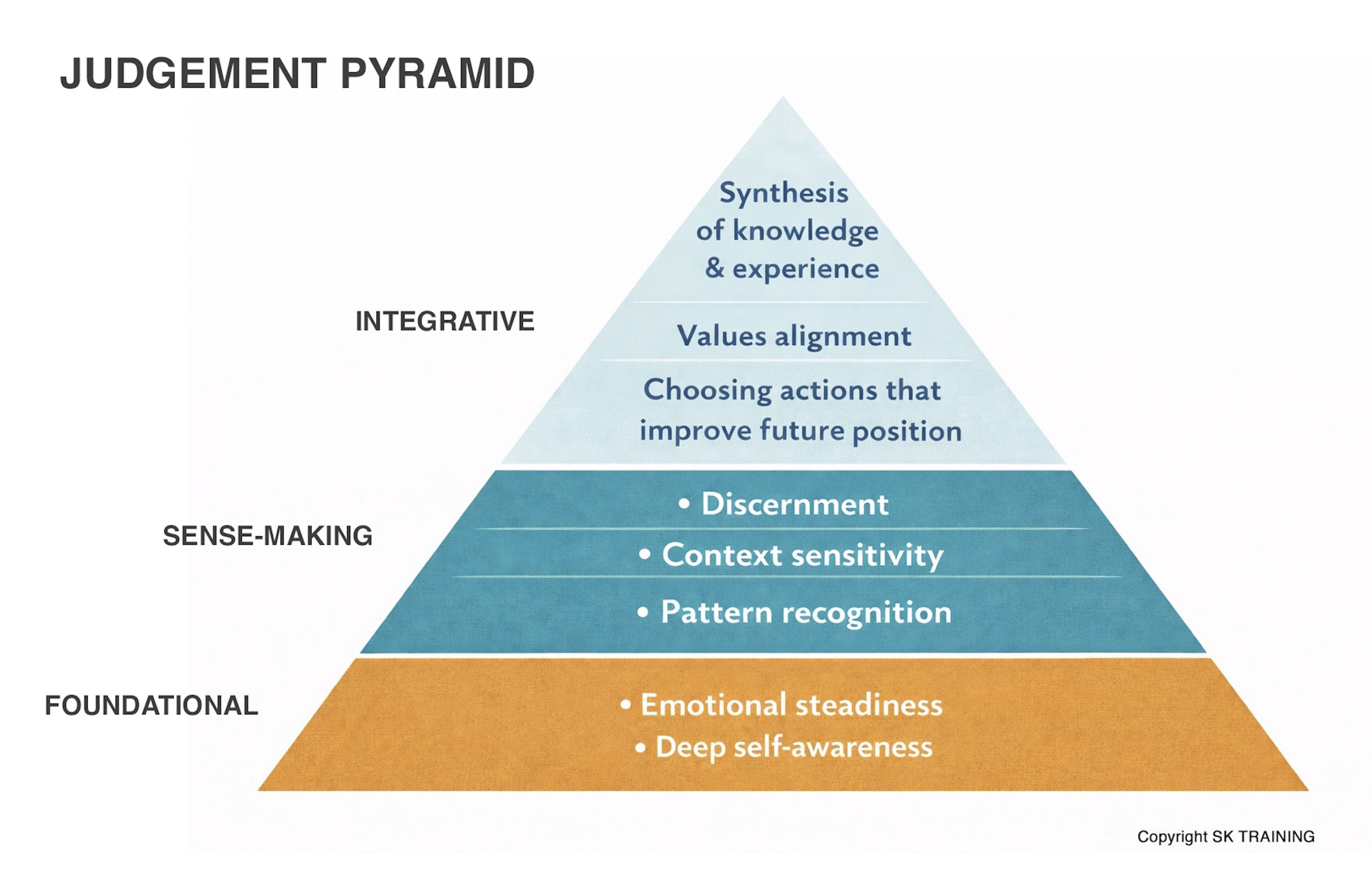
The Pyramid is not a hierarchy of judgement itself. It represents the layers that produce judgement.
Foundational → self-mastery: the basis that supports everything else
Sense-making → clarifies reality (signal, context, patterns)
Integrative → connects the dots (synthesis, alignment, meta view)
Judgement emerges when all three layers are functioning well.
Great judgement cannot be taught, but it can be learned.
Its development can be accelerated through:
Repeated exposure to consequence
Experiential (tacit) learning
Feedback loops
Growing of intellectual knowledge
Encounters with art and aesthetic experience
Emotion: The Servant, Not the Driver
“The biggest threat to good decision making is harmful emotions.”
- Ray Dalio, PRINCIPLES
Poor judgement comes from being driven by emotion. Good judgement comes from being informed by emotion without being hijacked by it. This is a critical distinction. The goal is not emotional suppression – it is emotional awareness: understanding what you are feeling, why you are feeling it, and what it may be telling you – without letting it take over.
On Intuition
Intuition is frequently misunderstood. It is not guesswork. Useful human intuition is pattern recognition earned through lived experience.
When a leader "just knows" something is off in a deal, or "has a feeling" about a candidate that turns out to be correct, they are drawing on a library of pattern data accumulated across years of consequential decisions. This pattern recognition is a skill. The trick is to know the difference between intuition and emotional reactivity. Emotional intelligence and self-awareness guides us in that.
On Reading
There is one investment that pays off disproportionately, and it is often undervalued: deep reading. Not podcasts. Not book summaries. Not highlight reels. Those formats have their place, but they tend to produce verbal fluency rather than decision-making depth. Books are different. A well-written book is an extended, structured argument. It builds mental models progressively and asks the reader to think on a subject long enough for seeds of wisdom to be planted.
The advantage of being well-read is not the accumulation of information. It is the internalization of high-quality ideas that enable fast pattern recognition and judgement in real-time situations – whether they be conversations, negotiations, or high-stakes decisions. That payoff will show up if reading is deep and it is paired with reflection and real-world practice.
Besides reading strategically to build domain expertise, I recommend studying philosophy. Read a wide range of philosophy books intended to help us think and live more skillfully, from ancient to modern and from eastern to western. When approached with curiosity and a desire to find personal applications, philosophy books grow our critical thinking skills and add to our synthesized wisdom. Reading philosophy helps us get to know ourselves, get out of your own way, and reason with clarity.

Increasing the Probability of the Right Call
Shane Parrish puts it plainly: "Amateurs think in absolutes. Experts think in probabilities."
There are no universal formulas. No guaranteed methods. No playbook that works every time across every context. In professional judgement, we are simply working to increase the probability of a good outcome, and decrease the probability of a bad one.
Having strong judgement, which combines tacit knowledge, useful intuition, rigorous thinking, and contextual understanding does not guarantee the right answer. But it does shift the odds significantly in your favour.
This is the work:
Cultivate each layer of the Judgement Pyramid
Invest in reading, training, and coaching
Step into situations with real consequences
Pay attention to what experience is trying to teach you
Trust that judgement compounds quietly. When it matters, it’ll be there.
In a world where AI handles more and more of the work, the person known for wise judgement becomes more valuable.
Judgement is the reputation that survives every disruption.