

Your Mental Performance Profile

“Self-awareness has three components: understanding your underlying value system, identifying your innate preferences—your work style and decision-making tendencies—and being clear about your own skills and capability gaps.”
- Claire Hughes Johnson, Scaling People: Tactics for Management and Company Building
We Are All Wired Differently
Deep self-awareness must include an understanding or what leads to our best cognitive ability. We talk a lot about focus, productivity, bandwidth, overwhelm, and burnout. We talk far less about neurological diversity from person to person and how work can be designed to take advantage of personal optimal conditions.
Occasionally, I am asked how one should navigate workplace challenges if they have ADHD. The traits we associate with ADHD – distractibility, emotional intensity, difficulty with mundane tasks - exist across all human brains. Nobody has zero distractibility. Nobody is immune to overwhelm. What differs is the degree and the point at which those traits create friction. But these traits also bring along with them positive benefits that can be leveraged as strengths: deep focus, emotional attunement, pattern recognition, and creative thinking.
We are all wired differently. Even neurotypical brains function differently from person to person. In terms of delivering results, being neurodivergent doesn’t mean an inability to be a top performer – just as being neurotypical doesn’t result in automatic achievement. Self-awareness and optimizing for innate preferences is key. People who understand and work intelligently with their own mental performance characteristics (peak windows, friction points, ideal conditions) will consistently outperform others who are operating without that self-knowledge.
Given we are all different, we each need to understand our own Mental Performance Profile.

What is a Mental Performance Profile?
Your Mental Performance Profile is the unique pattern of how your brain manages itself in pursuit of goals. At its heart is what neuroscience calls executive function, the cluster of capacities that govern attention, the ability to initiate tasks, emotional regulation, sustaining a task through to completion, and more.
These capacities vary across people. They also vary within a single person – across contexts, energy levels, and conditions. Understanding your own profile of optimal cognitive performance across these dimensions is one of the most practically useful things you can do for your performance and leadership effectiveness.
Flow - An Optimal State of Consciousness
There is a state of performance that most high achievers have experienced but few can reliably access on demand. Psychologist Mihaly Csikszentmihalyi called it flow – complete absorption in a challenging, meaningful task where performance feels effortless, time disappears, and output reaches its highest quality.
Steven Kotler, in The Rise of Superman, took this concept further, documenting how elite performers across domains deliberately engineer the conditions that reliably produce flow states. His research identified specific triggers that invite flow: high consequences, deep embodiment, rich environment, clear goals, immediate feedback, and the right challenge-to-skill ratio.
For most people, flow is a happy accident. For high performers who understand their own Mental Performance Profile, it becomes something more intentional.

Strategies for Peak Performance
1. Know your Mental Performance Profile. Design and execute accordingly.
Deliberately consider:
When am I at my best: what conditions, what type of challenge, what environment?
What energizes me beyond what seems rational?
What drains me disproportionately?
What environmental conditions (noise level, time of day, social context, etc.) surface your flow state easily and reliably?
Where do I consistently underperform relative to my own expectations, and what is actually happening in those moments?
When, what workspaces, and what circumstances allow me to be unusually creative?
This is a kind of strategic self-knowledge. Understanding your flow triggers and what inhibit your abilities is crucial to success. It transforms peak performance from something that happens to you into something you intentionally design.
Organize your highest-priority work into the windows and conditions that are most useful for you. Get great at being attuned to your motivation, energy levels, fluctuating mood throughout the day. As much as you can, take on tasks that are optimal for those signals.
Methodical planning and execution like this leads to sustainable peak performance.
2. Build metacognitive skills
One of the highest-leverage skills for anyone with a demanding Mental Performance Profile is the ability to observe your own patterns in real time. To notice "I am starting to feel overwhelm" before you are fully in it, to catch the spiral early, to intervene while your executive function is still available.
This is a trainable skill. It builds through practice. And it compounds: each rep of noticing-and-choosing lays down the neural pathway a little more firmly. Over time, what required effortful awareness becomes a faster, more automatic response.
More on metacognition -> here
3. Build your nervous system's capacity, not just your habits
Habits and systems are important. But they run on the underlying nervous system. Practices that grow your capacities of emotional and mental energy is important for ensuring sustainable peak performance. Those practices include: consistent physical exercise, good sleep, a healthy diet, and mindfulness training.
The threshold at which overwhelm hits is not fixed. It can be raised systematically through the right kind of deliberate training.
4. Lead others with this understanding
If you lead people, the practical reality is this: you are almost certainly leading neurodivergent people right now, whether they have disclosed it or not. The team member who is brilliant in a crisis and struggles with repetitive tasks. The one who produces extraordinary work under high pressure but appears disengaged when the stakes seem low. The one who takes feedback harder than you'd expect, but can also detect nuanced emotions in others. Even without a formal diagnosis, it’s important to understand that we are all wired differently and therefore have our own optimal conditions to be mindful of.
Great leaders don't just manage results. They develop an understanding of how their people operate, and help determine how to work in an effective, burnout-free way.

In Conclusion
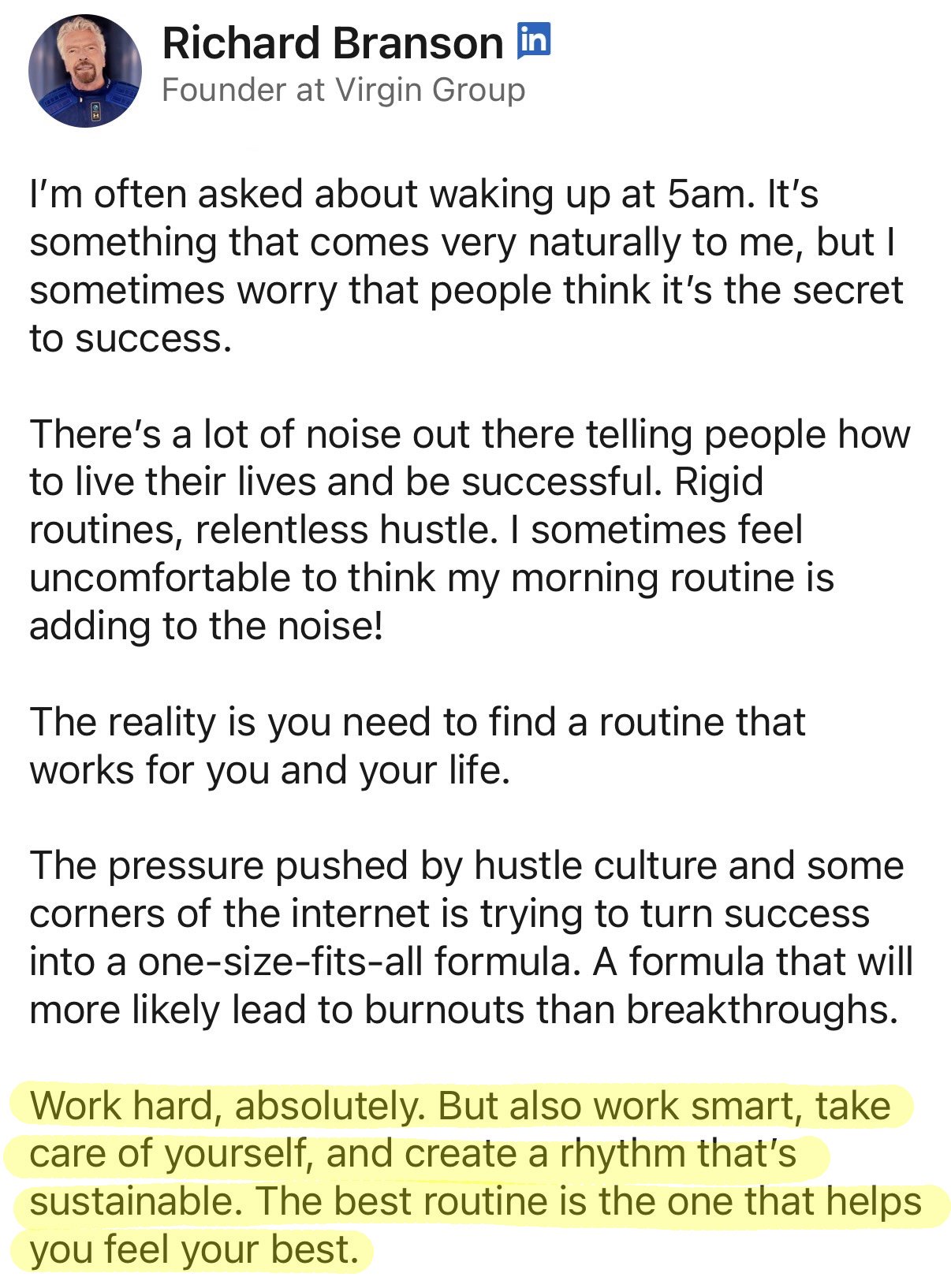
via LinkedIn July 3, 2026
Understanding your Mental Performance Profile is an important part of overall self-mastery. And learning to design around what you need to be at your best will create the conditions for your best performance.