

Your Personal Brand

Definition
Personal branding, at its core, is simply the intentional shaping of how others perceive you professionally: your reputation, expertise, and the associations people make when they think of you.
Nowadays, when people think of personal brands, they think of the influencer-entrepreneur type, those who have built an audience-based business around their personality, like Alex Hormozi, Kim Kardashian, and Gary Vaynerchuk. But the influencer-entrepreneur personal brand is just one application, and arguably a fairly recent and narrow one.

Back to the Fundamentals
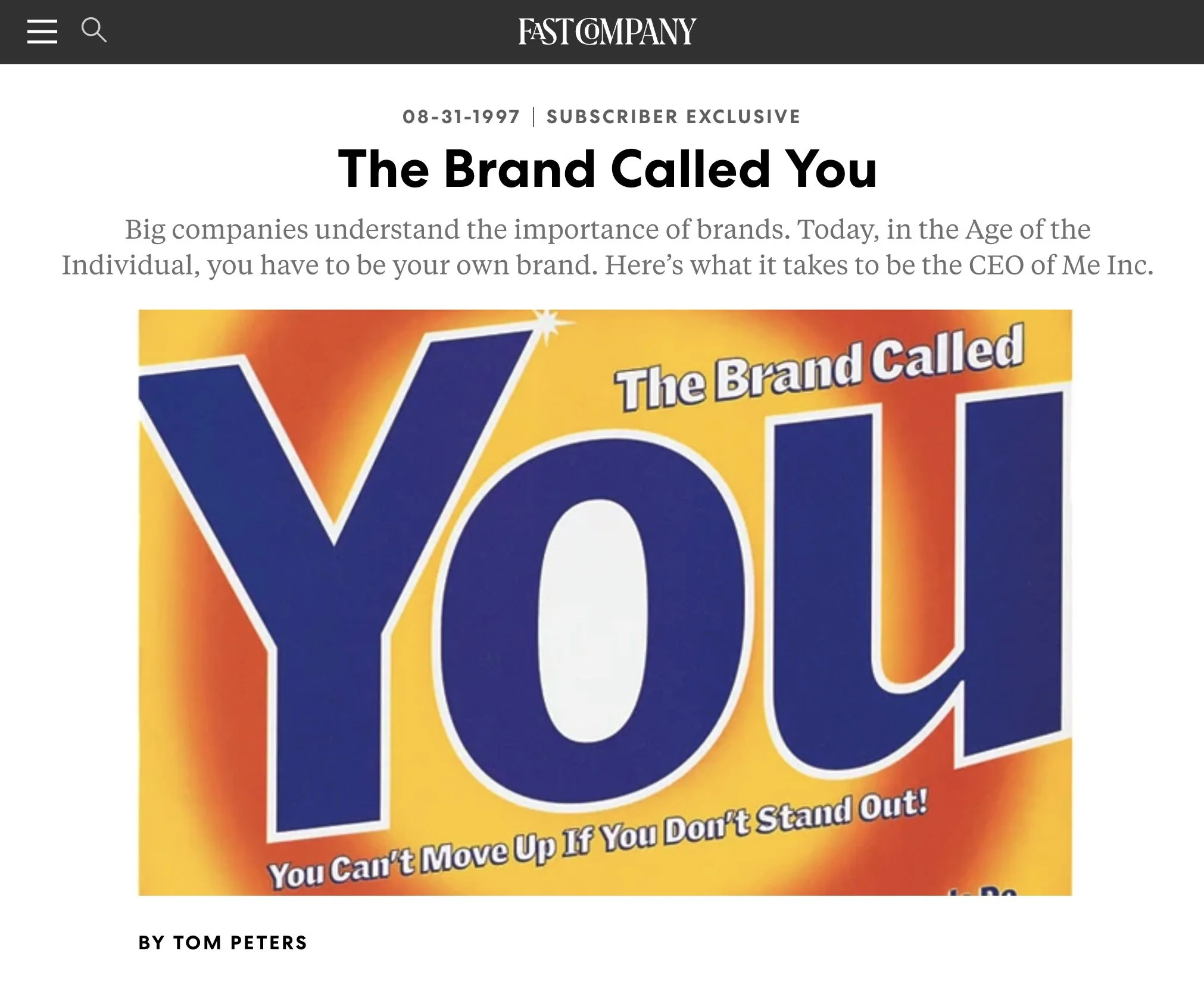
Image via Fast Company
The concept of Personal Brand was popularized in the 1997 Fast Company article by Tom Peters titled The Brand Called You. His argument was explicitly aimed at people in the corporate world, not entrepreneurs. His point was that in a modern economy, every professional is effectively a free agent managing their own career, and should think about what they’re known for, what value they deliver, and what makes them distinctive – regardless of where they work.
For a professional in an organizational environment, personal branding principles include:
Recognizability: being the person known for a specific skill, domain, or perspective within your organization or industry
Authority: consistently producing work or ideas that make people think of you as the go-to person on something
Preference: being top of mind when opportunities arise (projects, promotions, referrals, speaking invitations)
Career optionality: having a reputation that goes with you across companies or roles, so you’re not starting from zero each time
The key distinction is that personal branding for a corporate professional operates mostly within networks: colleagues, managers, industry peers, LinkedIn, conferences – rather than at mass public scale. The mechanisms differ (you’re not posting YouTube content), but the underlying logic is identical: be intentional about what you want to be known for, then consistently signal and demonstrate that.
The influencer version gets more cultural airtime because it’s visible and dramatic, but it’s really just personal branding turned up to a public, monetized extreme.
I don’t do the social media influencer thing. I work with executives and high performers on the more fundamental version of Personal Brand.

Strategies for Building a Compelling Personal Brand
A summary of fundamentals, in no particular order:
Be different.
Have a point of view. And have substance behind that point of view.
Understand branding principles such as Strategic Direction and Strategic Expression, and then develop a Brand Guideline around them.
Execute on your Brand Guideline to create a consistent Brand Experience
Be aware of your disempowering emotions. They will show up, if even subtly. Fear in particular can hold you back, whether that be fear of being seen, of failure, or of “rejection”. As always, personal mastery is key.
Get great at storytelling. It’s just a skill. Learn it.
Take aesthetics seriously. Develop a signature personal style and energetic presence that is consistent with your brand.
Get great at in-person networking. Do what most will avoid (often due to fear).
Get known for your expertise: find opportunities to be aligned with respected others.
Master the lost art of trust building. Having a reputation of 100% integrity will return a disproportionate benefit because it’s so rare.
Get yourself into a good position over time. Be consistent over a long time horizon. Most personal brands fail not from bad strategy but from inconsistency and impatience.

Ghetto Country Brandmother® | Personal Brand Consultant | Image: gcbrandmother Instagram
“…most brands don’t need more polish. They need a behavioral gut check. Because you can’t build trust, authority, or a following by editing out the very thing that makes you distinct and magnetic.”
- Phyllis Williams-Strawder
In a crowded field, being better is often not as important as being different. Expertise gets you in the room, but a distinctive, well-crafted personal brand is what makes you the obvious choice once you're there.
Reputation compounds. Play the long game.
Recommended Books
ZAG, by Marty Neumeier
Building A Story Brand, by Donald Miller
Aesthetic Intelligence, by Pauline Brown
Power: Why Some People Have It - And Others Don’t, by Jeffrey Pfeffer
So Good They Can’t Ignore You, by Cal Newport
Pocket Full of Do, by Chris Do
POP!, by Sam Horn